
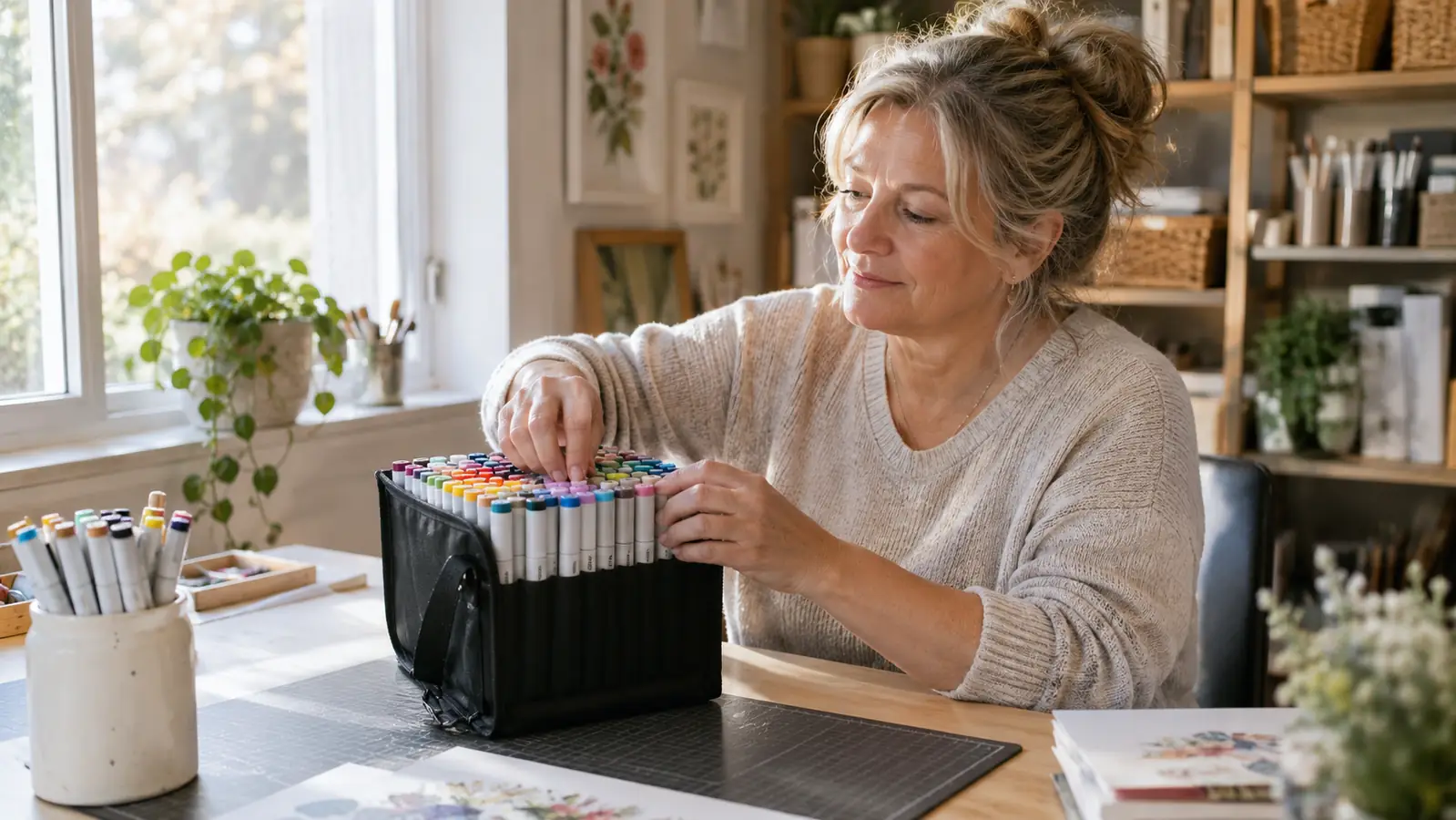
I will tell you the thing most marker reviews will not: the Ohuhu 100-color set is not the marker that will make your coloring look like an Instagram post. It is the marker that will make you actually sit down and color, which is a different and better thing. I am Paula, a retired middle school art teacher, and I have spent the last several months using this set almost daily in my craft room for card making, coloring pages, and the occasional sketch. I bought it with my own money, I have no reason to flatter it, and I have strong opinions about the chisel tip that nobody seems to mention.
Before I go further, here is the short version. The Ohuhu set is a genuine bargain for hobbyists, the color range is generous, and the double tips are genuinely useful. But it is also a set with real quirks: the color names on the barrel do not match the color names on the cap, the lighter colors need two passes to look smooth, and the case, while pretty, is not built for the way most people actually store markers. If you are a working illustrator who needs exact color consistency across refills, this is not your tool. If you are a hobbyist who wants a big, forgiving palette without spending Copic money, this might be exactly right.
The Quick Verdict
A generous, easy-to-love marker set for hobbyists, with a few quirks that matter more to professionals than to people coloring at a kitchen table.
Amazon Check Today's Price →The 100-color set that made me put down my colored pencils
After months of daily use, the Ohuhu set is still the first thing I reach for at my craft table. If you want a big, blendable palette without the professional price tag, this is the one to start with.
Amazon Check Today's Price on Amazon →How I've Used It
I have been teaching art and making things with my hands for long enough to be skeptical of anything that promises to replace a professional tool. So when I ordered the Ohuhu 100-color set, I did not expect to love it. I expected a serviceable budget marker that I would use for rough sketches and then set aside. What I got was the marker I now reach for first, almost every day, for card making and coloring pages.
My routine is simple. I sit at the folding table under the window in my spare bedroom, which I long ago turned into a craft room. I pull out the standing case, pick a handful of colors, and work on whatever card or coloring page is in progress. I have mild arthritis in my right thumb, so I notice how much pressure a marker needs. The Ohuhu markers are comfortable to hold for an hour or two, and the chisel tip lets me cover a large area without pressing hard. That matters to me more than I expected it would.
Most sessions start the same way. I tape a scratch sheet under the page, pull the six or seven Ohuhu markers I need from the case, and swatch each one on the edge of the scratch sheet before it touches the page. That swatch habit came from teaching. I watched hundreds of students commit to a color that looked right on the barrel and wrong on the paper, and a ten second swatch prevents that every time.
I have used the set for three kinds of work: coloring pages with fine detail, handmade cards with large background areas, and quick sketches where I want a loose, paintery look. The set handles all three, though not equally well. The fine tip is excellent for small spaces. The chisel tip is the workhorse for backgrounds. The blending, which I will get to, is good but has a learning curve.
What Nobody Tells You About the Ohuhu Set
Here is the honest part. There are four things I wish someone had told me before I bought the Ohuhu 100-color set, and none of them are deal breakers. They are just the difference between a review written from the box and a review written after three months of use.
First, the color names on the barrel do not always match the color names on the cap. The cap is the color you see when the marker is closed, and the barrel has a printed name and number. On some markers, the name on the barrel is a different shade name than the cap suggests. It does not affect how the marker performs, but it will confuse you the first time you try to organize by name. I organize by number and swatch everything on paper, which solves the problem completely.
Second, the lighter colors need two passes. If you are used to alcohol markers that lay down full color in one stroke, the pale yellows, pinks, and lavenders in this set will look streaky at first. The fix is simple: go over the area a second time once the first pass is dry. The second pass smooths it out. This is normal behavior for alcohol markers in this price range, but it is the kind of thing you only learn by using them.
Third, the case is not the best way to store the markers long term. The standing case that comes with the set is attractive and it holds all 100 markers, but the markers sit loosely in their slots. If you carry the case around, the markers rattle and some can slip out. I keep mine in the case on my rolling cart, and it is fine. If I were traveling with them, I would use a different storage solution.
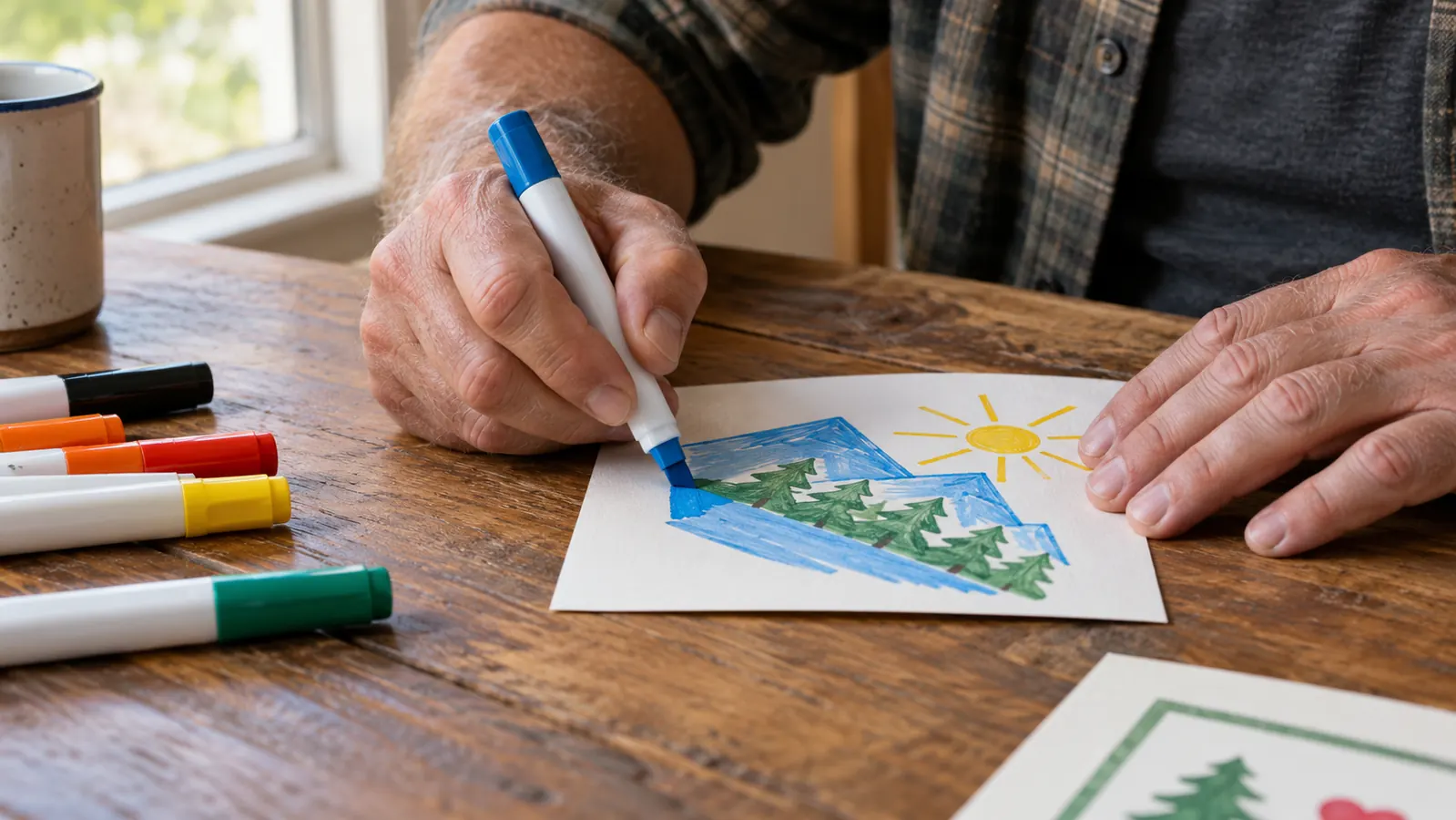
Fourth, the chisel tip is wider than you expect. The set is described as chisel and fine, and the chisel tip is a true broad chisel. It is wonderful for backgrounds and large shapes, but it is not a brush tip. If you are hoping for brush-style strokes, this set does not have them. You can get a separate brush tip set from Ohuhu, but the 100-color set is chisel and fine only.
The lighter colors need two passes. Once you learn that, the whole set opens up.
The Color Range and How It Behaves
The Ohuhu 100-color set covers a wide range of hues, from soft pastels to deep darks, with a good spread of neutrals and skin tones. For a hobbyist, that range is the difference between a set you use for one project and a set you use for everything. I have made cards with autumn leaves, ocean waves, and a very silly birthday cake, and I have not once wished for a color that was not in the case.
The ink is alcohol based, which means it dries quickly and does not smear once dry. It also means it will bleed through thin paper. If you are coloring in a book with thin pages, put a scrap sheet underneath. I learned this the way everyone learns it, by ruining the back of a page I cared about. The markers are also AP certified, which matters to me because I sometimes craft with friends who bring young kids along, and I like knowing the ink is rated for safety.
Blending is where the Ohuhu set surprises people. You can blend two colors by laying down the lighter color first, then adding the darker color at the edge and going back over the boundary with the lighter marker while the ink is still wet. It takes practice, and the window is shorter than with more expensive markers, but the results are genuinely good. I have made gradients on cards that my craft group assumed were done with a much more expensive tool.
The method that works best for me is light to dark. I lay down the lightest color first, add the middle tone while the first layer is still damp, then go back over the join with the lighter color to soften it. With the Ohuhu set that takes small circles and a light hand. Press hard and the chisel tip floods the paper and the blend turns muddy.
The Double Tips: Chisel and Fine
The double ended design is the reason I reach for these markers instead of my older single tip set. The fine tip is precise enough for the small details in coloring pages, like the veins on a leaf or the petals on a tiny flower. The chisel tip is the surprise. I expected to use it rarely, but it has become my favorite tool for covering large areas quickly. A background that would take twenty minutes with a fine tip takes three minutes with the chisel.
The chisel tip also works well for lettering. If you hold it at an angle, you can get a nice variation in stroke width, which is useful for card sentiments. I have made several birthday cards where the word itself became the design. That is not something I could do easily with a round tip.
For my card making, the fine tip does most of the outlining and small accents, and the chisel tip fills larger shapes and backgrounds. A typical card front uses both ends of four or five markers. Having both tips on one barrel means fewer caps on the table and less hunting, which keeps me in the flow of the work.
One honest note: the fine tip is not as fine as a dedicated fine liner. It is fine for a marker, but if you need hairline details, you will still want a pen. I keep a black fine liner in my drawer for the last details on a card. The Ohuhu fine tip handles everything else.

Who This Is For
The Ohuhu 100-color set is for the hobbyist who wants a big palette without a big price. It is for the adult coloring book user who is tired of colored pencils and wants to try alcohol markers. It is for the card maker who wants to cover backgrounds quickly and add fine details without switching tools. It is for the beginner who is not sure if they will stick with markers and does not want to spend a fortune to find out.
It is also for the person with hand pain. I have mild arthritis in my right thumb, and the light pressure required by these markers makes a real difference. I can color for an hour without the ache I get from pressing with a pencil. That alone would make me recommend them to anyone with similar hands.
Who Should Skip It
If you are a working illustrator who needs exact color consistency across multiple sets and refills, skip the Ohuhu set. The color names on the barrel and cap do not always match, and that kind of inconsistency will drive you crazy when you are trying to match a specific color for a client. You are better off with a system where every color has a single, reliable code.
If you specifically want brush tips, skip this set. The chisel and fine tips are excellent, but they are not brush tips, and no amount of angling will make a chisel behave like a brush. Ohuhu makes brush tip sets, but this particular 100-color set is not one of them.
If you color on very thin paper and refuse to use a scratch sheet underneath, skip alcohol markers entirely. They bleed. That is physics, not a flaw in the Ohuhu set, but it will still ruin pages until you adapt.
Most of the frustration people report with these markers comes back to paper rather than the Ohuhu set itself. Smooth, heavy cardstock or a marker pad gives clean color with no bleeding. Ordinary printer paper soaks the ink and spreads it. Change the paper before you change the markers.
How It Compares to What I Expected
I expected a budget marker that would feel like a compromise. What I got was a marker that feels like a tool, not a toy. The Ohuhu set has a solid, comfortable body, a cap that clicks on securely, and ink that behaves predictably. The color range is broad enough that I have stopped reaching for my old markers entirely.
The compromises are real, but they are the compromises of a hobbyist tool, not a defective one. The lighter colors need two passes. The case rattles. The color names are inconsistent. None of these stop me from using the set every day. They are just things I wish a review had told me before I bought it, so I am telling you now.
What surprised me most was how quickly the set stopped feeling like a budget choice. After a few weeks I was no longer thinking about the markers at all. I was thinking about the picture in front of me, which is the best thing I can say about any art supply.
What I Liked
- 100 colors cover a wide range, including good neutrals and skin tones
- Chisel tip covers large areas quickly and works for lettering
- Fine tip handles small details well
- Light pressure needed, comfortable for hands that ache
- Alcohol ink dries fast and blends well with practice
- AP certified, which matters if kids are around
- Refillable, so you can replace a single color instead of the whole set
Where It Falls Short
- Color names on the barrel do not always match the cap
- Lighter colors need two passes to look smooth
- Case rattles and markers can slip out if carried
- No brush tip in this set
- Ink bleeds through thin paper without a scratch sheet
The set I keep reaching for, quirks and all
The Ohuhu 100-color set is not perfect, but it is the marker I use every day. If you are a hobbyist who wants a big palette without the professional price, this is the honest recommendation.
Amazon Check Today's Price on Amazon →